Mentorship Powers the Future of Health Informatics
How UCF alumnus Vincent Evans ’21MS-HCI is helping shape the next generation — one student at a time, starting with Ayanna Williams
When UCF alumnus Vincent Evans ’21MS-HCI agreed to mentor a graduate student he barely knew, he didn’t see it as a formal obligation or a résumé line item; he saw it as an opportunity to do for someone else what had once been done for him.
“I could tell she just needed someone in her corner,” Evans says. “Sometimes that’s all it takes.”
His decision to stay involved, to answer questions, to show up consistently has made all the difference for Ayanna Williams, a master’s student in the UCF College of Community Innovation and Education online health care informatics program and the current health informatics manager at Clay Behavioral Health Center outside of Jacksonville.
Their story is not just about career success. It’s about what happens when alumni choose to mentor with intention — and how that choice can build confidence, shape careers and create the future of a fast-growing field.
From uncertainty to opportunity
Williams began her career knowing she wanted to work in health care, but not yet knowing where she fit. After earning a bachelor’s degree in health sciences from Florida A&M University, she explored occupational therapy and quickly realized clinical care was not the right path. What intrigued her instead was data — and the systems behind patient care.
Working in radiology and quality improvement at UF Health in Gainesville exposed her to analytics, patient safety initiatives and electronic health records. An attempt at an MBA confirmed what she already suspected.
“I absolutely hated it,” Williams says, laughing. “I had to find something else.”
She found that “something else” in UCF’s health care informatics program — and, soon after, in a job opening that would unexpectedly connect her to Evans.
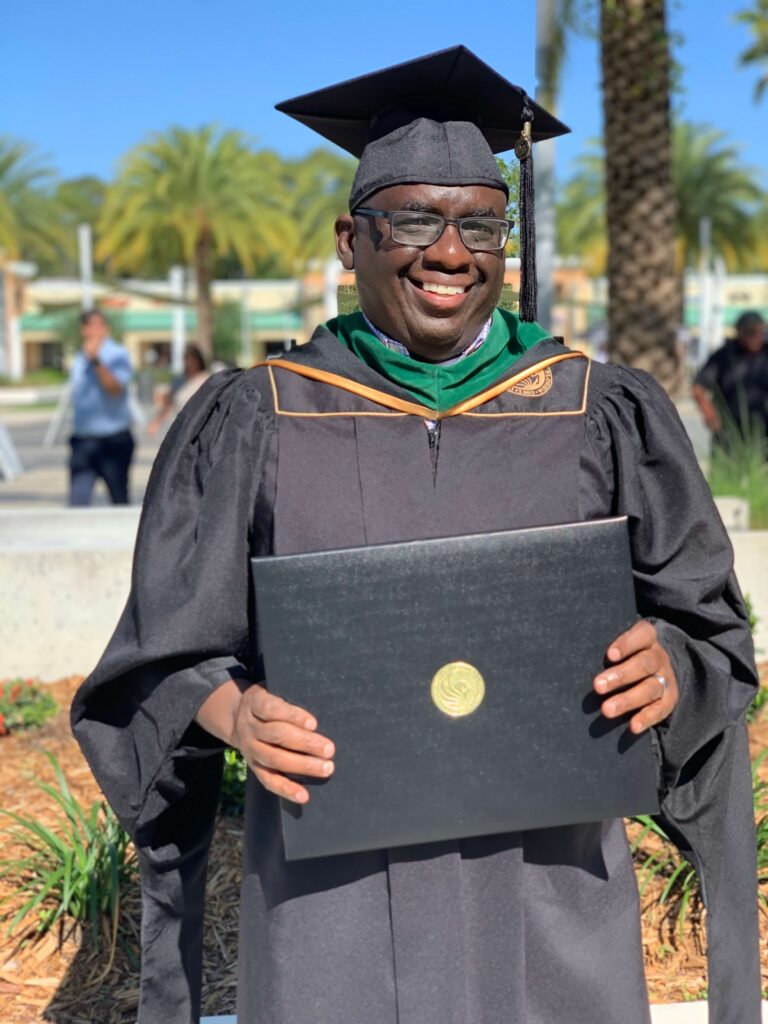
Evans had previously held the health informatics manager role at Clay Behavioral Health Center. When he left for a new position at Mayo Clinic, he remained involved in the hiring process. When Williams’ application came across his desk, he took notice.
“She had the right mix of health care experience and curiosity,” Evans says. “I could tell she would grow into the role.”
Williams was hired — and quickly realized she was stepping into a position with no in-house training.
A mentor who stayed
Although Evans had already moved on professionally, he chose not to step away entirely.
Instead, he committed to weekly check-ins with Williams, guiding her through EHR (electronic health rcords) configuration, system administration, reporting tools and the realities of implementing technology in a small, change-resistant clinical environment.
More than a year later, those meetings continue.
“I tell her all the time, ‘It’s your system,’” Evans says. “You can build anything. You can fix anything. And if you don’t like it, you can always change it back.”
That steady reassurance has helped Williams grow into a role that now includes overseeing EHR form design, business intelligence reporting, data governance, medical records and the rollout of new AI tools — all while working full time and completing graduate coursework.
“He’s never made me feel like I’m asking too many questions,” Williams says. “He just shows me how to think through problems and trust myself.”
Mentorship as confidence-building
For Williams, mentorship has been especially critical during moments of self-doubt — something Evans recognizes as common for early-career professionals navigating complex systems.
“There are days she’s nervous to try something new,” Evans says. “And I remind her that sometimes you have to pioneer things. That’s how systems get better.”
Williams credits that encouragement with helping her push past fear, particularly when implementing new technology for clinic staff.
“There are days I’m scared to try something new because I worry how people will react,” she says. “And he tells me, ‘Don’t be afraid.’ That changes everything.”
Evans is quick to emphasize that mentorship doesn’t require perfection or extraordinary effort — just consistency.
Want to change someone’s life by becoming a mentor? https://ucfalumni.com/chargeonmentorship/
“It’s about staying available,” he says. “Checking in. Sharing what you’ve already learned.”
Supported by faculty — strengthened by mentorship
Williams’ experience has also been shaped by strong faculty support within the program. She credits UCF’s health care informatics Program Director Michelle Crozier, Ph.D. and staff member Hannah Nguyen for helping her navigate unexpected challenges, including a temporary pause in coursework due to tuition timing.
Because Williams’ professional responsibilities closely mirror the curriculum, Crozier approved her to substitute an internship with an advanced health care data analytics course that will award an SAS (Statistical Analysis System) credential.
“The faculty genuinely want you to succeed,” Williams says. “They meet you where you are.”
But it is to Evans’ mentorship that Williams returns again and again when reflecting on her growth.
“I would not be where I am today without him,” Williams says.
Paying it forward
Williams plans to complete her degree in spring 2027 and hopes to relocate to Orlando, where health informatics opportunities are expanding at major health systems such as AdventHealth and Orlando Health, two of UCF’s inaugural Pegasus Partners.
When asked what she hopes others take from her story, she doesn’t hesitate.
“Don’t be afraid to pivot,” Williams says. “And don’t be afraid to accept help. Having a mentor has been life changing.”
Evans hopes alumni reading this story see something else — an invitation.
“You don’t have to have all the answers,” he says. “You just have to be willing to help someone figure things out.”