Christian Stanley ’11: Making Street Art With Purpose
By Trina Gray
Through vibrant, large-scale murals, UCF alum Christian Stanley ’11 is harnessing the power of art to revitalize communities and draw attention to the beauty of the natural world.
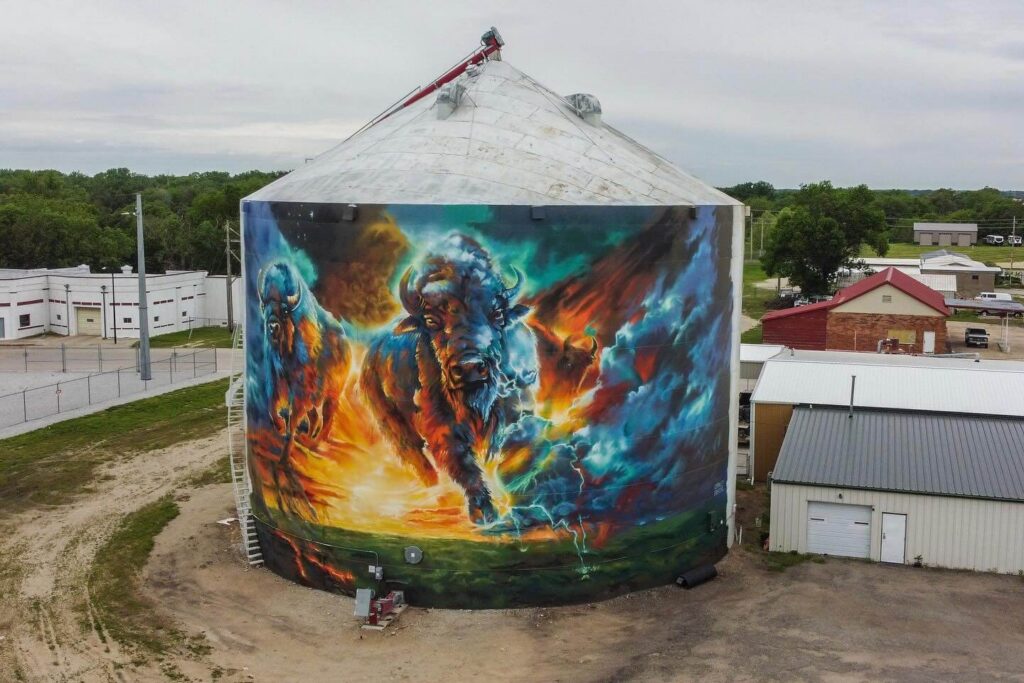
The mural “Prairie Thunder,” painted on a multi-story CVA grain bin in Clay Center, Kansas, looks like a cinematic Western scene come to life: A herd of American bison, illuminated by a fiery sunset and storm clouds, charge through an open prairie, hints of springtime burnings peeking through charred grass and shrubs.
The image tells a powerful story of a Midwestern agricultural heartland, shaped by a symbiotic relationship between humans and nature. For Orlando-based artist Christian Stanley, who completed the monumental 3,800-square-foot piece in May 2024, the work offered an opportunity to center native wildlife within the built environment — making visible what is often obscured by urban development.
“Public art helps reconnect people to the land,” says Stanley, a UCF College of Arts and Humanities alum who co-founded C. Stanley Creative with his business partner and wife, Jessica, in 2018. “By presenting images at such a large scale, murals can raise awareness, shift perspectives and invite viewers to reconsider their relationship with the places or objects those images represent.”
Although his artistic career began only recently, Stanley has quickly earned global recognition. His work can be found in cities across the U.S. and abroad — from Memphis, Tennessee, to Sibiu, Romania — and in 2025 “Prairie Thunder” won the prestigious Region 5 Gold National Mural Award and was named one of the Top 50 new murals in the world by Street Art Cities in its annual “Best Of” Awards.
Like many artists, Stanley showed a creative bent from an early age, often getting into trouble at school for “always doodling” in his sketchbook. One anecdote he likes to share from his childhood is when his kindergarten teacher instructed the class to make newspaper cutouts of goldfish for an art project. “That felt kind of boring to me,” he says. “So I made this really cool sailfish with a big fin on top and a long pointy nose. I wanted to do something more outside the box and different from the rest of the class.”
Stanley saw a future in art, but turning that passion into a career would require the same unconventional thinking he brought to his practice. “I knew early on that art was something I wanted to do,” he says. “But I wasn’t sure how to translate that into a full-time job, so graphic design felt like a safe way to continue doing what I love while remaining commercially viable.”
Born in Stuart, Florida, Stanley graduated from UCF in 2011 with a BFA in graphic design. Though he credits the program with teaching him how to network and project manage — skills he relies on as an independent artist and business owner — he found the art classes to be most beneficial to his technique. Drawing and sketching, especially, showed him the process of refinement: the painstaking task of working meticulously on a piece until the composition and details effectively communicate the artist’s message.
“Spending so many hours in the art room at UCF, I learned that the more you put into your craft, the more you get out of it,” he says. “I remember hanging up all of my drawings at the end of an art portfolio class and thinking, ‘Wow, this looks really cool.’ That was also when I realized that I liked seeing all of my artwork together on a large scale.”
After college, Stanley worked as a graphic designer for a local sign shop, where he learned to scale his illustrations for larger formats, including billboards and vehicle wraps. That background made him a natural fit for public art. In 2018, he painted a small electrical box in Ivanhoe Village as part of a community art initiative. Then came the 2019 Sam Flax Wall Project, a one‑day mural‑painting event featuring selected artists and hosted every three years by the Orlando art supply store. From there, the requests began to line up, and within a few years, his business grew from a local venture to commissions in other states.
When the COVID-19 pandemic hit, the art world seemingly came to a halt. While many artists saw exhibitions canceled and studio opportunities shrink, forcing them to seek work in other sectors, Stanley had enough mural projects to leave his 9-to-5 job as a graphic designer. He has since made his mark on Florida’s public art scene, infusing the state with a sense of pride and cultural identity — from the coastal ecosystems of Clearwater to the orange blossoms of Orlando’s Packing District to the iconic swans of Lake Eola.
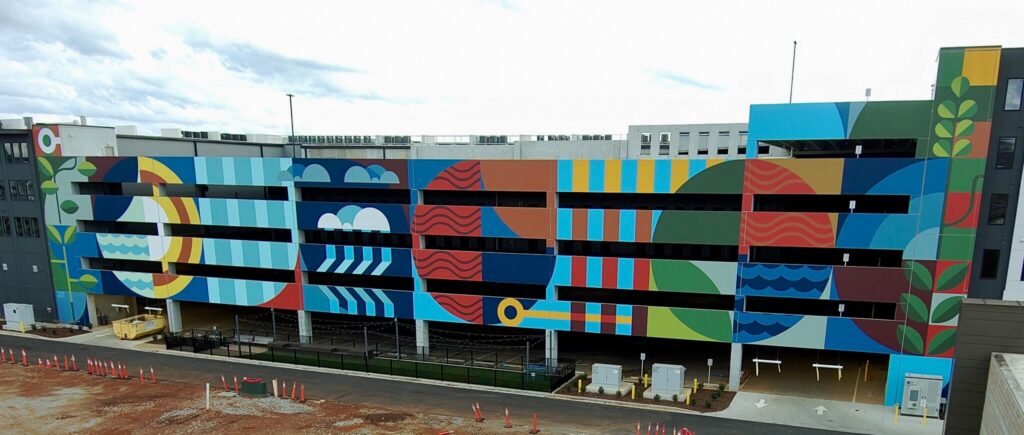
An avid outdoorsman, Stanley draws much of his creative inspiration from nature, often integrating wildlife imagery and environmental themes into his work. His artistic idiom deftly combines natural forms and realistic elements with the clean, geometric lines and bold colors of graphic design, making each mural distinct and reflective of its surroundings.
Before starting a mural project, Stanley and his wife will typically travel to the location to scope out the site — taking note of any windows, downspouts or doors to work around — and research the city’s history and character. They’ll also meet with the client to work through several rounds of edits before landing on a final composition.
“There’s definitely a dialogue with the people we work with,” Stanley says. “We’re kind of an outsider coming into these communities, so we lean on our clients to make sure we’re meeting their vision.”
Once a design is approved, Stanley transfers it onto the wall using a variety of methods, depending on the project. When a traditional projector isn’t feasible — say, when he lacks nighttime access to a site — AR goggles allow him to cast a scaled rendering onto the wall, adjust its opacity and trace precise outlines in chalk or pencil. He also relies on a technique known as the doodle grid method, which begins with marking the wall with scribbles, numbers or letters, photographing it, and then digitally overlaying the artwork. By making the images partially transparent, he can see both at once, capturing fine details and achieving a level of accuracy beyond a standard grid.
“Technology plays an important part in my work,” Stanley says. “It doesn’t replace the art, but it helps with precision and saves time so I can focus on the complex, creative aspects rather than logistical challenges.”
Mural art has a long history of cultural significance to public spaces. It can spark conversations, encourage civic engagement and shine a spotlight on hidden truths. Stanley’s works not only tell the story of a community; they communicate a poignant message about our place in the natural world, and our collective role in caring for the diverse yet fragile ecosystems that sustain us.

“I take pride in knowing my art gives a voice to the plants and animals that otherwise can’t speak for themselves,” Stanley says. “My hope is that by presenting these creatures and environments in a larger-than-life format, it will remind people of what’s here — and that it’s worth protecting.”